
19 July 2026
Hourly vs Project Pricing: Which Should Freelancers Use?
By Abhishek V K · Founder, DigitalItUp
The short answer
Charge hourly when scope is genuinely unknowable - ongoing maintenance, open-ended consulting, discovery work. Charge per project when deliverables can be defined, because project pricing rewards speed and experience instead of punishing them. Most freelancers should default to project pricing built on an internal hourly floor: estimate the hours honestly, multiply by your minimum acceptable rate, add a 20–30% buffer, and quote one number.
What's actually wrong with hourly billing?
Hourly pricing contains a built-in penalty: the better you get, the faster you finish, the less you earn for the same outcome. It also makes clients watch the clock instead of the result, which turns every invoice into an audit. Hourly is not evil - it is simply the wrong tool for defined deliverables, where the client is buying an outcome, not your afternoon.
When each model wins
- Hourly: retainers, maintenance, debugging, consulting where scope shifts weekly
- Project: websites, logos, articles, campaigns - anything with a definable finish line
- Hybrid: a fixed-price project plus an hourly rate for out-of-scope additions
- Day rate: intensive engagements like workshops, audits, or on-site sprints
The hybrid deserves more use than it gets. A fixed price gives the client certainty; a published hourly rate for extras gives you a built-in answer to scope creep. Both numbers live in the same proposal, so when the client asks for something extra in week three, the price for it already exists and nothing needs renegotiating mid-project.
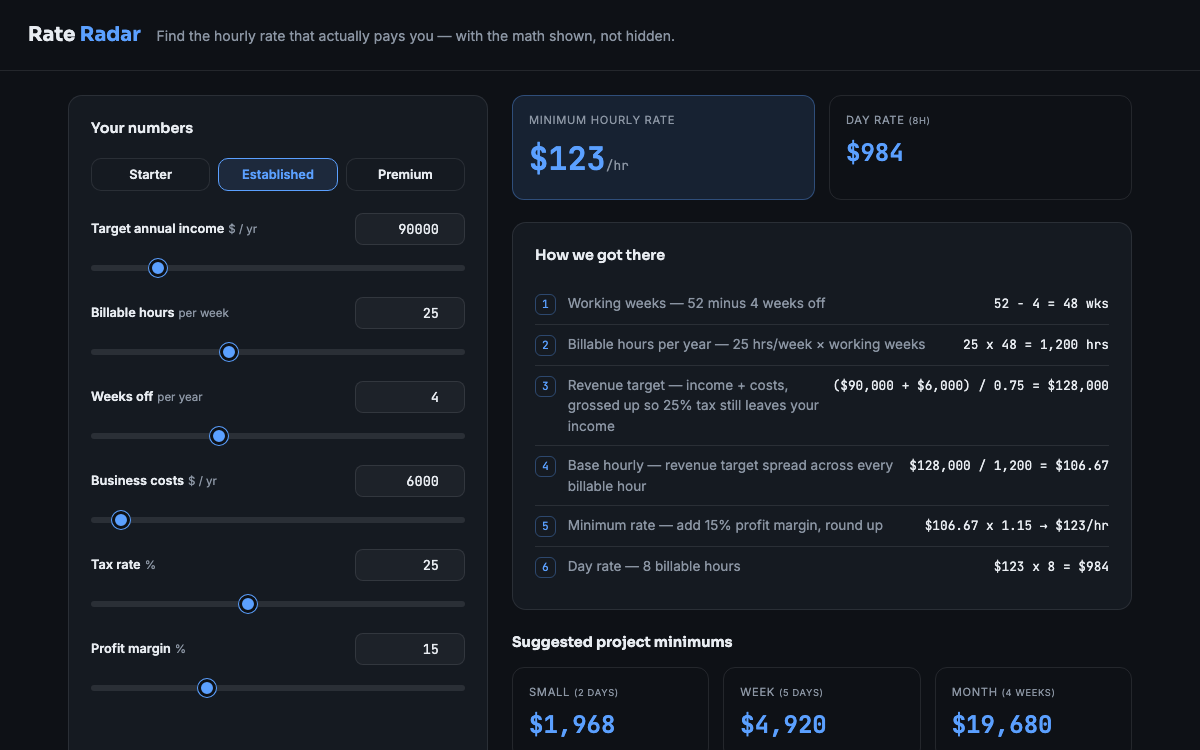
Every good project quote hides an hourly floor inside it. Estimate the real hours - including calls, revisions, and admin, which freelancers chronically forget - multiply by the minimum rate your finances require, then add a 20–30% buffer for the surprises every project contains. Rate Radar walks through that entire formula with your own numbers, so the floor is calculated rather than guessed. For the strategy layer above the math - packaging, anchoring, and quoting outcomes instead of hours - the Charge More pricing guide picks up where the calculator ends.
Put this into practice
All products →The tools and templates behind this guide - instant download, yours forever.
 Software
Rate Radar
A freelance rate calculator that shows its work - defend your rate in any client call.
 Ebook
EbookCharge More - The Freelance Pricing Guide
For freelancers who are underpricing and know it.
 SoftwareBeta
QuietScribe (Beta)
Private meeting notes for Mac - transcripts, summaries and action points, processed on your Mac.